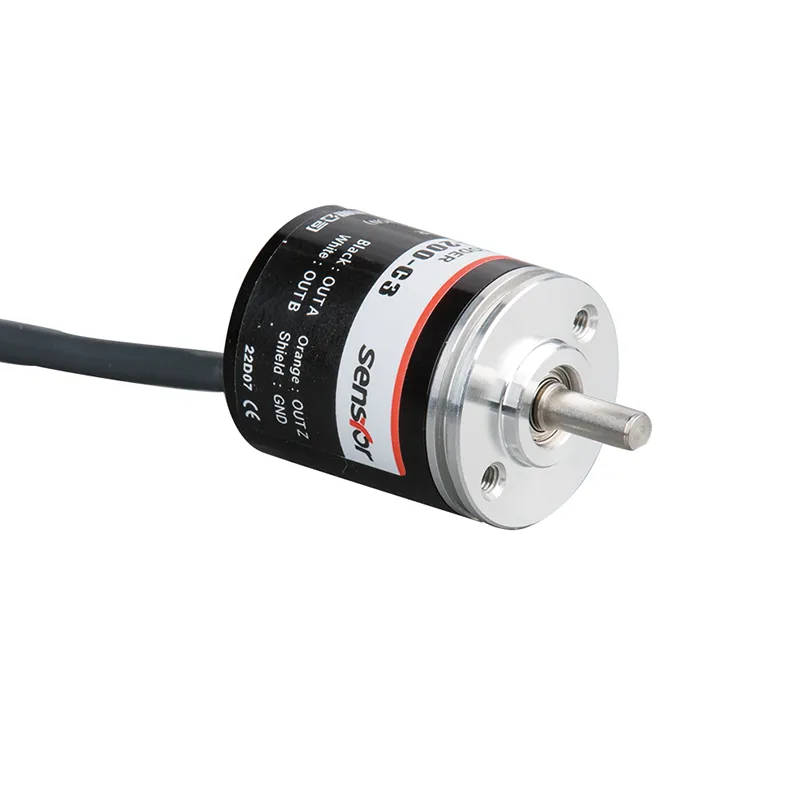
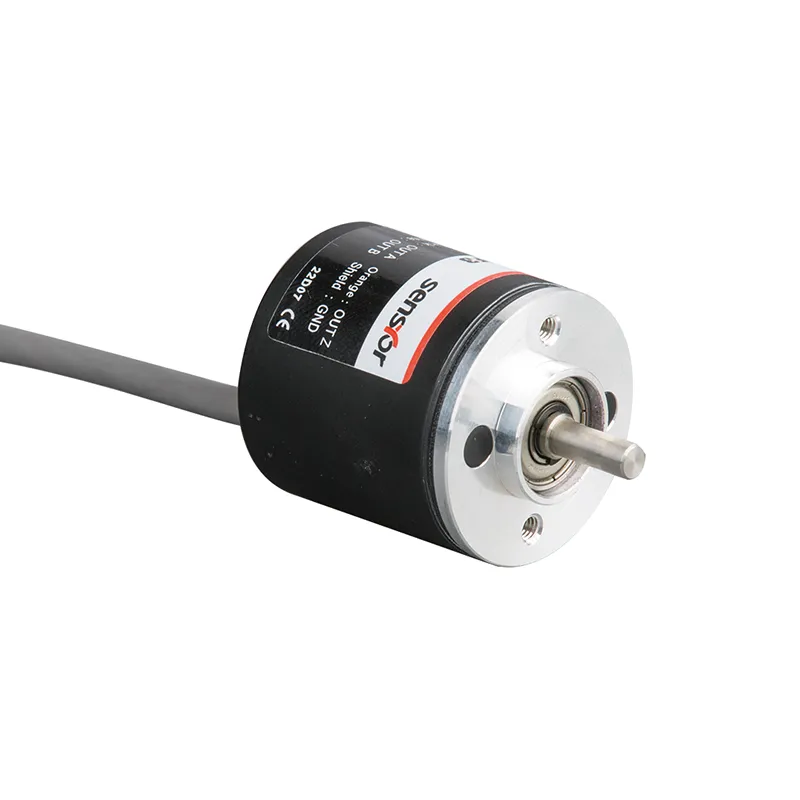
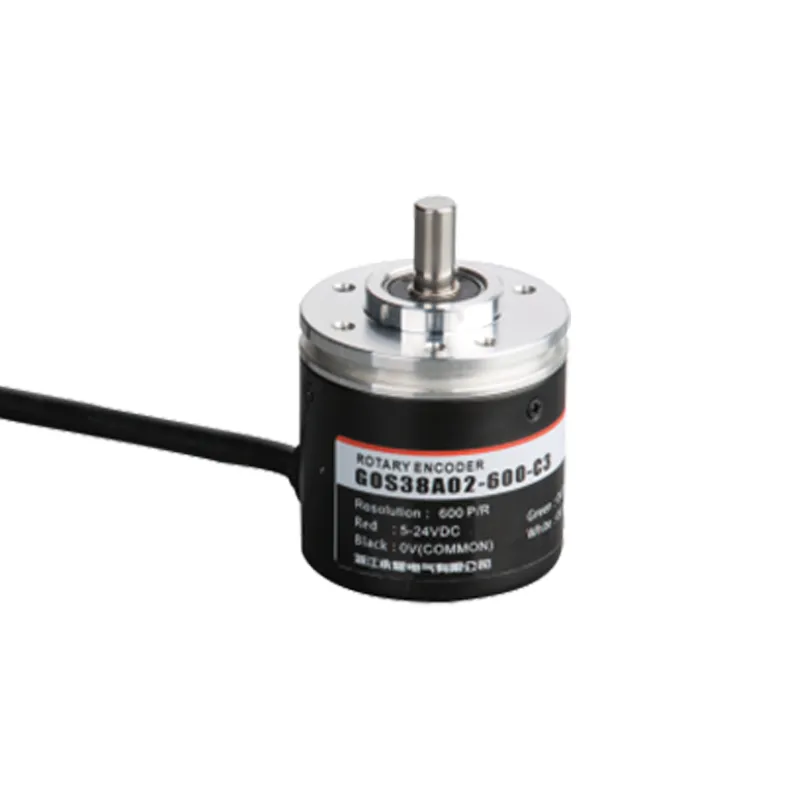
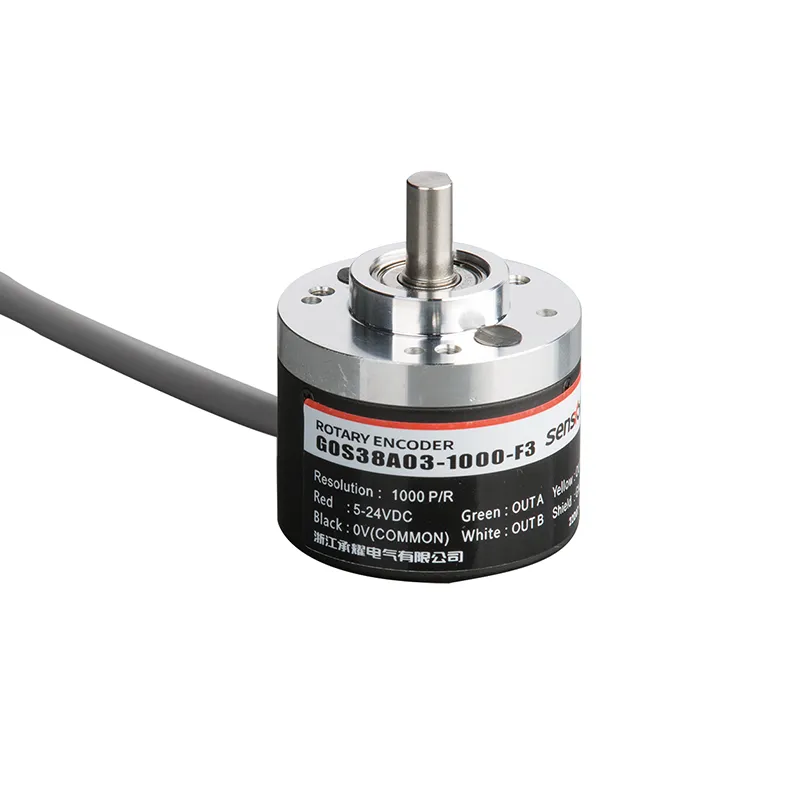
An absolute rotary encoder is a position-feedback device that provides a digital or coded representation of shaft position. Unlike a conventional incremental encoder, an absolute encoder is designed to identify a specific shaft position rather than relying only on accumulated pulses from movement.
Absolute rotary encoders can be used in automation equipment, robotics, machine tools, servo systems, material-handling equipment, and other applications where position feedback is required.
When selecting an absolute rotary encoder, engineers should consider resolution, single-turn or multi-turn operation, communication interface, supply voltage, maximum speed, mechanical dimensions, environmental conditions, and controller compatibility.
An absolute rotary encoder is a rotary position sensor that assigns a specific output value or digital code to shaft position.
The control system reads the encoder’s output and determines the corresponding angular position.
This differs from an incremental rotary encoder, which generally produces pulses as the shaft moves. With an incremental encoder, the control system typically tracks movement by counting or interpreting those pulses.
An absolute encoder instead provides position information associated with the shaft’s current position.
Depending on the design, an absolute rotary encoder can be available as:
Single-turn encoder
Multi-turn encoder
Parallel-output encoder
Serial-interface encoder
Other application-specific configurations
The exact output technology depends on the encoder design.
How Does an Absolute Rotary Encoder Work?
An absolute rotary encoder uses a sensing mechanism to identify the angular position of its rotating shaft.
The encoder converts the shaft’s mechanical position into an electrical output that the controller can interpret.
Different absolute encoder technologies use different sensing and coding methods.
The general process can be summarized as:
Mechanical rotation → position detection → encoded output → controller
The controller then uses this information as part of the machine’s feedback system.
Absolute Position Feedback
The main characteristic of an absolute rotary encoder is that each measurable shaft position is associated with a defined output value.
This can be valuable in applications where the controller needs position information rather than simply knowing that the shaft has moved.
The actual resolution determines how finely the encoder can distinguish angular positions.
Single-Turn and Multi-Turn Encoders
Absolute encoders can generally be divided into single-turn and multi-turn configurations.
Single-Turn Absolute Encoder
A single-turn absolute encoder measures position within one revolution.
Once the shaft completes a revolution, the position value returns to the corresponding position in the next revolution.
Single-turn designs can be suitable for applications where only angular position within one revolution is required.
Multi-Turn Absolute Encoder
A multi-turn absolute encoder can provide information about both angular position and the number of revolutions, depending on its design.
This makes multi-turn encoders useful for applications involving extended rotational travel.
The specific operating principle and revolution-counting method vary between encoder technologies.
Absolute Rotary Encoder Resolution
Resolution is a critical specification when selecting an absolute rotary encoder.
For absolute encoders, resolution may be expressed in bits rather than pulses per revolution.
For example, an encoder with an N-bit position value can theoretically represent:
2ᴺ positions per revolution
A 12-bit single-turn encoder therefore represents:
2¹² = 4,096 position values
A 16-bit encoder represents:
2¹⁶ = 65,536 position values
These values describe the theoretical number of distinguishable digital position states according to the specified resolution.
However, resolution is not the same as overall system accuracy.
Real-world position performance can also depend on factors such as:
Encoder construction
Mechanical installation
Shaft movement
Bearing condition
Signal processing
Control-system characteristics
Environmental conditions
Therefore, buyers should evaluate both resolution and the manufacturer’s stated performance specifications.
Absolute vs Incremental Rotary Encoder
Understanding the difference between an absolute rotary encoder and an incremental encoder can simplify product selection.
Feature
Absolute Rotary Encoder
Incremental Rotary Encoder
Position information
Absolute position value
Relative movement information
Typical output
Digital code/interface
Pulses/signals
Position tracking
Based on encoded position
Based on signal interpretation/counting
Single-turn option
Yes
Common
Multi-turn option
Available depending on design
Depends on system/configuration
Typical consideration
Absolute position feedback
Speed, direction, relative position
Interface
Depends on encoder
Depends on encoder
Neither type is universally better.
The correct choice depends on the machine’s control architecture and feedback requirements.
For applications that need absolute position information, an absolute rotary encoder may be appropriate.
For applications that primarily need pulse-based speed, direction, or relative position feedback, an incremental encoder may be more suitable.
Applications of Absolute Rotary Encoders
An absolute rotary encoder can be considered for many industrial applications.
Industrial Automation
Automation systems may require position feedback for motors, actuators, rotating mechanisms, and positioning equipment.
An absolute encoder can provide position information to the control system when the interface and specifications are compatible.
The encoder’s permitted operating speed should be appropriate for the machine.
Check the manufacturer’s specified maximum rotational speed and compare it with the actual application.
The required speed should be considered together with resolution and signal-processing requirements.
5. Mechanical Dimensions
An absolute rotary encoder must physically fit the machine.
Check:
Housing diameter
Housing length
Shaft diameter
Shaft length
Mounting holes
Flange
Connector location
Installation clearance
Always use the manufacturer’s mechanical drawing when checking dimensions.
6. Environmental Conditions
Evaluate the actual operating environment.
Relevant conditions may include:
Dust
Water
Oil
Humidity
Temperature
Vibration
Mechanical shock
Select an encoder whose specified environmental characteristics match the machine’s operating conditions.
7. Power Supply
Confirm the encoder’s required supply voltage.
The encoder’s electrical requirements should be compatible with the machine’s available power and controller interface.
Incorrect power supply selection can cause improper operation or equipment damage.
8. Shaft and Mounting
Shaft compatibility is particularly important.
Check whether the encoder uses:
Solid shaft
Hollow shaft
Blind hollow shaft
Other mechanical configurations
Also check the required coupling and mounting structure.
9. Controller Compatibility
The final selection must be compatible with the receiving control system.
Check the encoder against:
PLC
Servo drive
Motion controller
CNC controller
Industrial network
Feedback module
An encoder with excellent specifications may still be unsuitable if its interface cannot communicate with the machine controller.
How to Install an Absolute Rotary Encoder
Correct installation helps ensure that the encoder provides reliable feedback.
Step 1: Review the Mechanical Drawing
Confirm all mounting and shaft dimensions before installation.
Step 2: Check Shaft Alignment
Ensure that the encoder and machine shaft are installed according to the manufacturer’s mechanical requirements.
Avoid excessive radial or axial loads.
Step 3: Secure the Encoder
Use appropriate mounting hardware and follow the manufacturer’s installation instructions.
Step 4: Connect the Electrical Interface
Follow the correct wiring diagram and pin assignment.
Never assume that connector pinouts are identical between different encoder manufacturers.
Step 5: Configure the Controller
Set the appropriate encoder parameters in the PLC, servo drive, CNC system, or motion controller.
Step 6: Test the Position Feedback
Rotate the shaft and verify that the controller receives the expected position information.
Step 7: Test Under Operating Conditions
After basic commissioning, test the encoder at the expected operating speed and environmental conditions.
Common Absolute Encoder Problems
Even a correctly specified absolute rotary encoder can experience problems if installation or integration is incorrect.
Position Data Is Incorrect
Check:
Encoder configuration
Communication settings
Mechanical installation
Shaft coupling
Controller parameters
No Communication
Possible areas to investigate include:
Power supply
Wiring
Connector
Communication settings
Controller interface
Pin assignment
Position Changes Unexpectedly
Investigate:
Mechanical movement
Shaft coupling
Mounting
Electrical connections
Configuration
Environmental vibration
The exact cause should be determined using the encoder’s technical documentation and the machine’s control architecture.
How to Select an Absolute Rotary Encoder Supplier
When choosing an absolute rotary encoder supplier, evaluate both technical and commercial capabilities.
Important factors include:
Product specifications
Manufacturing capability
Technical documentation
Sample availability
OEM customization
Quality control
Production capacity
Lead time
Technical support
Export support
For OEM projects, suppliers should also be able to discuss mechanical drawings, electrical interfaces, application requirements, and customization feasibility.
Why Consider Sensyor Rotary Encoder Products?
Selecting an absolute rotary encoder should begin with the actual machine requirements.
Sensyor provides rotary encoder products for industrial applications.
For OEM applications, a mechanical drawing and controller information can also be useful when evaluating compatibility.
FAQs About Absolute Rotary Encoders
What is an absolute rotary encoder?
An absolute rotary encoder is a position-feedback device that provides a defined output value corresponding to the shaft’s angular position.
How does an absolute rotary encoder work?
An absolute encoder detects the shaft’s angular position and converts that position into an encoded electrical output that a compatible controller can interpret.
What is the difference between an absolute and incremental rotary encoder?
An absolute encoder provides position information associated with the shaft’s position, while an incremental encoder generally produces pulses representing relative movement.
What is a single-turn absolute encoder?
A single-turn absolute encoder measures the shaft position within one revolution. Its position value corresponds to an angular position within that revolution.
What is a multi-turn absolute encoder?
A multi-turn absolute encoder can provide information about shaft position across multiple revolutions, depending on its design and revolution-counting technology.
Is higher absolute encoder resolution always better?
No. Higher resolution can provide more distinguishable position values, but the appropriate resolution depends on the machine, controller, mechanical system, and actual positioning requirements.
Can an absolute rotary encoder be used with a PLC?
Yes, provided that the encoder’s communication or output interface is compatible with the PLC or an appropriate interface module.
Can an absolute rotary encoder be used with a servo motor?
Yes. An absolute encoder can be used in servo applications when its mechanical configuration, feedback interface, resolution, speed rating, and other specifications are compatible with the servo system.
What specifications should I provide when buying an absolute rotary encoder?
Provide the application, encoder type, resolution, single-turn or multi-turn requirement, communication interface, supply voltage, maximum speed, shaft dimensions, mounting requirements, environmental conditions, and controller information.
Where can I find industrial rotary encoder products?
An absolute rotary encoder provides position feedback by associating the encoder shaft’s angular position with a defined output value.
Compared with incremental encoders, absolute encoders can be useful when a control system requires absolute position information. Depending on the application, buyers can choose between single-turn and multi-turn configurations and different communication interfaces.
However, encoder selection should not be based on resolution alone.
Engineers should evaluate resolution, operating speed, communication interface, power supply, shaft dimensions, mounting, environmental conditions, and controller compatibility.
For OEMs and machine builders, technical documentation, sample testing, customization capability, production capacity, and supplier support can also be important.
If you are sourcing an absolute rotary encoder for industrial automation, robotics, servo systems, CNC equipment, packaging machinery, textile machinery, or other industrial applications, define the complete machine requirements before selecting a product.
Table of Contents Encoder Factory Introduction Encoder factory operations play a vital role in the industrial automation industry. An encoder factory designs, manufactures, tests, and supplies precision encoders used in motion control, robotics, CNC machinery, packaging equipment, and automated production lines. As industrial automation continues to expand, selecting a reliable encoder factory becomes increasingly important. […]
📊 Comprehensive Outline for “24V encoder” Heading Level Topic H1 24V Encoder: 15 Smart Ways to Boost Industrial Accuracy H2 Introduction to 24V Encoder H3 What is a 24V Encoder H3 Why Voltage Matters in Encoders H2 How a 24V Encoder Works H3 Signal Output and Power Supply H3 Electrical Characteristics H2 Types of 24V […]
Table of Contents Introduction A slim rotary encoder is a compact motion feedback device widely used in modern industrial automation systems where installation space is limited but precision is essential. These compact sensing devices help machines achieve accurate position and speed control while maintaining a small mechanical footprint. For professional encoder solutions, visit:👉 https://sensyorcoder.net/products/ What […]
We use cookies to enhance your browsing experience, serve personalised ads or content, and analyse our traffic. By clicking "Accept All", you consent to our use of cookies.