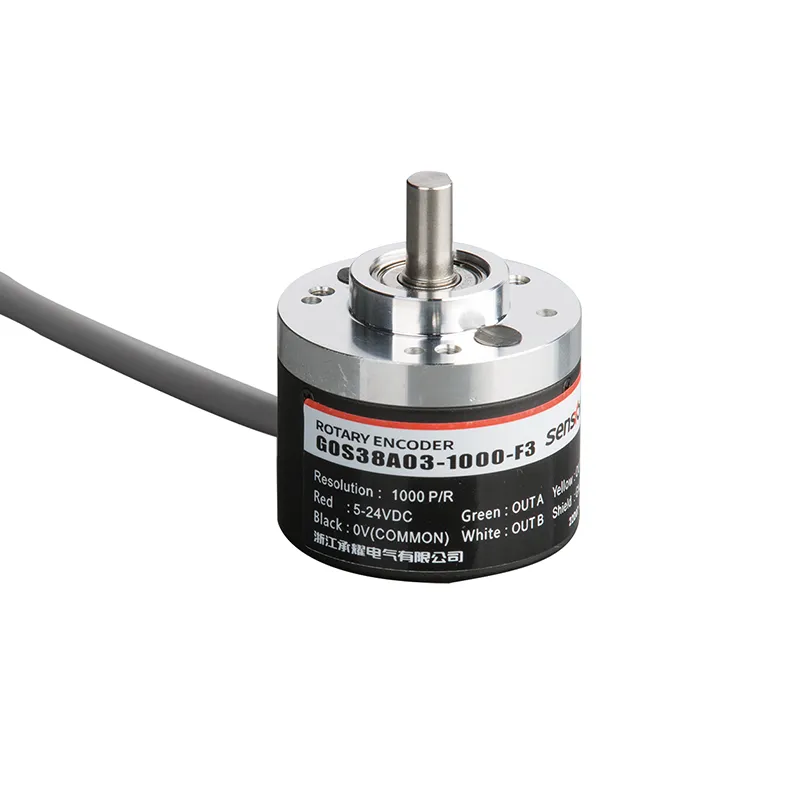
Finding the right rotary encoder manufacturer China supplier requires more than comparing unit prices. Industrial buyers should evaluate manufacturing capability, encoder specifications, quality-control processes, technical documentation, customization support, production capacity, and communication before placing an order.
Chinese rotary encoder manufacturers can serve OEMs, machine builders, distributors, automation companies, and system integrators with different product and sourcing requirements. However, not every supplier has the same capabilities.
A practical supplier evaluation should therefore begin with your application requirements and then compare manufacturers against the same technical and commercial criteria.
If you are looking for industrial rotary encoder products, visit the Sensyor rotary encoder product page to review the available product range.
What Is a Rotary Encoder Manufacturer in China?
A rotary encoder manufacturer China supplier designs, produces, assembles, tests, or supplies rotary encoder products for industrial and automation applications.
Depending on the company, its capabilities may include:
Rotary encoder manufacturing
Product assembly
Mechanical component production
Electronic assembly
Encoder testing
OEM support
Product customization
Technical documentation
Bulk production
Export support
The term “manufacturer” should be evaluated carefully during supplier research.
Some companies manufacture products directly, while others may operate primarily as trading companies or distributors. For OEM buyers, understanding the supplier’s actual production capabilities can be important.
When evaluating a rotary encoder manufacturer China, ask whether the company can provide appropriate product documentation, technical drawings, samples, production information, and quality-control information for the encoder you are considering.
Why Source Rotary Encoders From China?
China is an important manufacturing base for many industrial components and automation products.
For international buyers, working with a rotary encoder manufacturer China supplier may offer access to a broad range of encoder configurations and OEM sourcing options.
Potential reasons companies investigate Chinese encoder suppliers include:
Product variety
OEM and customization possibilities
Manufacturing capacity
Competitive sourcing options
Bulk-order support
Export experience
Access to industrial component supply chains
However, purchasing decisions should not be based on country of origin or price alone.
A rotary encoder is part of a machine’s electrical and mechanical feedback system. Compatibility and reliability requirements should be clearly defined before comparing quotations.
9 Factors to Evaluate a Rotary Encoder Manufacturer China
1. Manufacturing Capability
The first question is whether the rotary encoder manufacturer China supplier has the production capabilities required for your order.
For OEM buyers, useful questions include:
What encoder models are manufactured?
What production capacity is available?
Does the supplier support custom configurations?
Can the supplier provide samples?
What are the normal production lead times?
Does the supplier have experience with industrial applications?
A supplier’s capabilities should be evaluated against your actual requirements rather than general claims.
2. Product Range
A suitable supplier should have encoder products that match your applications.
Depending on the manufacturer, product categories may include encoders for:
Different machines may require different encoder configurations.
For example, an OEM may need a specific:
Shaft diameter
Shaft length
Mounting configuration
Resolution
Output signal
Connector
Cable length
Housing
Mechanical dimension
When contacting a rotary encoder manufacturer China supplier, explain the application and technical requirements rather than simply asking for the cheapest encoder.
The manufacturer can then determine whether an existing model or customized configuration is appropriate.
6. Production Capacity
Production capacity becomes particularly important for distributors and OEM customers purchasing in volume.
Ask the supplier about:
Standard lead time
Monthly production capability
Sample lead time
Bulk-order lead time
Capacity during peak periods
Packaging requirements
A supplier may be suitable for samples but less suitable for larger recurring orders.
Therefore, production capacity should be evaluated against your expected purchasing volume.
7. Communication and Technical Support
Industrial encoder selection can involve technical questions.
A good supplier should be able to communicate clearly about:
Electrical compatibility
Mechanical dimensions
Resolution
Output signals
Installation
Environmental conditions
Customization
Production requirements
Clear communication can help reduce misunderstandings during product development and purchasing.
8. Sample and Testing Support
Before committing to a large order, OEM buyers may want to evaluate samples.
A sample can allow an engineering team to check:
Mechanical fit
Electrical output
Controller compatibility
Installation
Cable connection
Actual machine performance
When evaluating a rotary encoder manufacturer China supplier, ask whether samples can be provided before bulk production.
Sample testing should be performed under the actual application requirements whenever practical.
9. Export and Packaging Capability
International B2B buyers should also consider the supplier’s ability to prepare products for export.
Relevant factors may include:
Export documentation
Product labeling
Packaging
Shipping arrangements
Carton configuration
Protection during transportation
Commercial documentation
The requirements will vary according to the destination country and purchasing arrangement.
Types of Rotary Encoders to Consider
A rotary encoder manufacturer China supplier may offer different encoder technologies and configurations.
Incremental Rotary Encoders
Incremental encoders generate signals associated with rotational movement.
Depending on the output configuration, the control system can use the signals to determine:
Relative position
Speed
Direction
Pulse count
Incremental encoders are often considered for PLC systems, conveyors, motors, machine tools, packaging equipment, and other industrial applications.
Absolute Rotary Encoders
Absolute encoders provide position information associated with shaft rotation.
They can be considered when a control system requires absolute position information.
The communication interface must be compatible with the receiving controller or drive.
High-Resolution Rotary Encoders
Applications requiring detailed rotational feedback may use higher-resolution encoders.
However, higher resolution also means that the receiving controller may need to process a higher signal frequency in incremental applications.
Therefore, buyers should evaluate encoder resolution together with machine speed and controller capability.
How to Request a Rotary Encoder Quotation
A common mistake when contacting a rotary encoder manufacturer China supplier is sending only a product name.
A more useful RFQ should include as much technical information as possible.
Recommended RFQ Information
Provide:
Encoder application
Machine type
Motor model
PLC or controller model
Required resolution
Maximum rotational speed
Output type
Supply voltage
Shaft dimensions
Mounting dimensions
Connector requirements
Cable requirements
Environmental conditions
Required quantity
Target delivery schedule
For example:
We need a rotary encoder for a servo motor used in an automated packaging machine. Please provide available encoder models, resolution options, output type, supply voltage, maximum RPM, mechanical drawing, lead time, and quotation for our expected quantity.
This gives the supplier enough information to begin a meaningful technical evaluation.
How to Compare Chinese Encoder Suppliers
When comparing a rotary encoder manufacturer China with other suppliers, avoid comparing price alone.
A useful comparison table can include:
Factor
Supplier A
Supplier B
Supplier C
Product compatibility
Check
Check
Check
Manufacturing capability
Check
Check
Check
Technical documentation
Check
Check
Check
Sample availability
Check
Check
Check
Customization
Check
Check
Check
Quality-control information
Check
Check
Check
Production capacity
Check
Check
Check
Lead time
Check
Check
Check
Technical support
Check
Check
Check
Export support
Check
Check
Check
This approach helps purchasing teams compare suppliers using consistent criteria.
Price should be considered alongside technical suitability and total purchasing requirements.
How to Verify a Rotary Encoder Manufacturer China Supplier
Before entering a long-term purchasing relationship, perform reasonable supplier due diligence.
Useful steps can include:
Check the Product Documentation
Ask for official product datasheets, mechanical drawings, wiring information, and specifications.
Request Samples
Test the encoder with the intended machine or control system when possible.
Verify Technical Compatibility
Confirm that the encoder works with the intended PLC, servo drive, controller, or other receiving equipment.
Discuss Production Requirements
Ask about MOQ, lead time, production capacity, packaging, and customization.
Review Quality Information
Request relevant quality-control information and documentation applicable to the products being purchased.
Confirm Commercial Details
Clarify:
Quotation
Payment terms
Incoterms
Lead time
Warranty terms
Packaging
Shipping arrangements
The exact commercial terms should be agreed upon directly with the supplier.
Why Consider Sensyor as a Rotary Encoder Supplier?
When looking for a rotary encoder manufacturer China, buyers should evaluate the supplier based on product compatibility, manufacturing capabilities, technical communication, and application requirements.
Sensyor offers rotary encoder products for industrial applications.
For OEM and B2B purchasing inquiries, it is useful to provide complete technical information, including:
Application
Resolution
Maximum RPM
Output requirements
Supply voltage
Shaft dimensions
Mounting requirements
Controller model
Environmental conditions
Required quantity
This information can help determine which encoder configuration is appropriate for the application.
FAQs About Rotary Encoder Manufacturer China
How do I find a rotary encoder manufacturer in China?
Start by identifying suppliers that offer the encoder type and specifications required for your application. Then evaluate manufacturing capability, technical documentation, quality-control information, samples, customization support, production capacity, and communication.
What should I ask a rotary encoder manufacturer China supplier?
Ask about encoder specifications, resolution, output type, supply voltage, maximum RPM, shaft dimensions, mounting, environmental conditions, samples, MOQ, lead time, customization, and quality-control procedures.
Can Chinese rotary encoder manufacturers provide OEM products?
Some manufacturers may offer OEM or customized encoder configurations. Buyers should confirm the specific manufacturer’s customization capabilities and requirements directly.
How can I verify a Chinese rotary encoder manufacturer?
Request technical documentation, samples, company and production information, quality-control documentation, and commercial details. Testing samples with your intended equipment can also help verify product compatibility.
Are Chinese rotary encoders suitable for industrial automation?
Suitability depends on the specific encoder and application. Buyers should evaluate the product’s electrical, mechanical, environmental, and performance specifications rather than judging suitability by country of manufacture alone.
What specifications should I provide when requesting an encoder quotation?
Provide the application, machine type, required resolution, maximum RPM, output type, supply voltage, shaft dimensions, mounting requirements, controller or PLC model, environmental conditions, and expected quantity.
Can I order rotary encoder samples before bulk production?
Sample availability depends on the supplier and product. It is reasonable to ask a rotary encoder manufacturer China supplier whether samples are available for engineering evaluation before placing a larger order.
What is more important: encoder price or specifications?
Specifications and compatibility should be established first. A low-cost encoder that does not match the machine’s controller, mechanical configuration, or operating conditions may not be suitable for the application.
Can a rotary encoder manufacturer customize shaft and mounting dimensions?
Some manufacturers may support customization of mechanical and electrical configurations. The available options depend on the manufacturer’s production capabilities and the specific encoder platform.
Choosing the right rotary encoder manufacturer China supplier is an important decision for OEMs, machine builders, distributors, and industrial automation companies.
The evaluation should go beyond unit price. Manufacturing capability, product range, technical documentation, quality control, OEM support, production capacity, sample availability, technical communication, and export capabilities can all affect the sourcing process.
Before requesting a quotation, define your technical requirements clearly. Include the application, encoder resolution, maximum RPM, output type, supply voltage, mechanical dimensions, controller compatibility, environmental conditions, and purchasing quantity.
If you are comparing Chinese encoder suppliers for industrial automation, servo systems, PLC applications, CNC machines, robotics, packaging equipment, or other machinery, start with the complete technical requirements and then compare suppliers using consistent criteria.
📊 Comprehensive Outline for “24V encoder” Heading Level Topic H1 24V Encoder: 15 Smart Ways to Boost Industrial Accuracy H2 Introduction to 24V Encoder H3 What is a 24V Encoder H3 Why Voltage Matters in Encoders H2 How a 24V Encoder Works H3 Signal Output and Power Supply H3 Electrical Characteristics H2 Types of 24V […]
Table of Contents What is Encoder for Industrial Automation An encoder for industrial automation is a device that converts mechanical motion into electrical signals, which are interpreted by control systems for precise positioning and speed monitoring. Encoders can be incremental or absolute, depending on whether they provide relative or unique positional data. Modern manufacturing systems […]
We use cookies to enhance your browsing experience, serve personalised ads or content, and analyse our traffic. By clicking "Accept All", you consent to our use of cookies.